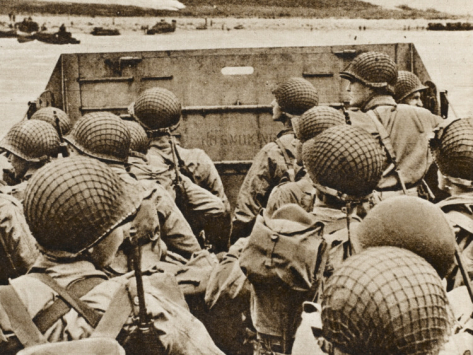
American Troops Land in Normandy During World War Two
Another Memorial Day is upon us. Today, in May of 2013, we are in the 12th year of the War in Afghanistan, we are ten years gone from the start of the War in Iraq, and now 22 years since the first War with Iraq, (better known as Operation Desert Storm), and the 100th anniversary of start of World War One is only a year away.
What does this roll call of wars and years really mean? Americans like to think of themselves as a peace-loving people who only go to war when necessary. Generally, that is not an inaccurate statement. Americans generally speaking, do not want more war. We are not ancient Sparta with its ingrained militaristic culture. Nor are we an ancient Athens, with an almost obsessive desire to spread out and establish new colonies everywhere. But we may be more like ancient Rome. Suddenly thrust into superpower status, with economic and political ties to many regions far from home, we send our troops and our treasure far and wide. Often, it is to protect our allies. Frequently, there is an economic or financial relationship to an intervention. And, most of America’s conflicts are usually couched in terms of a moral imperative. Frequently, that moral impetus is also tied to more hard-nosed political, military, diplomatic, and/or economic realities. All of these reasons, or excuses, if you will, add up to an amazingly large number of wars, conflicts, military interventions, and American casualties over the years.
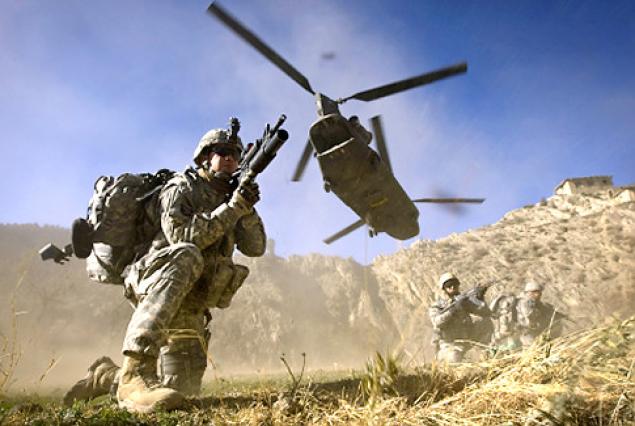
American Troops in the Afghanistan War
An American born in 1913 would be one hundred years old now. In the span of that person’s life, America has fought quite a few major wars, and has been engaged in numerous smaller wars. Let’s look at a list of American foreign wars and conflicts since 1913. The wars that are generally considered by historians as “Major Wars,” are in bold.
- 1912-1933—U.S. occupation of Nicaragua, including the Sandino War (1927-1934)
- 1913—In the Philippines, American territory since the Spanish-American War of 1898, the U.S. Army fights the last battles against the Moros (members of a Filipino Muslim group).
- 1914—The U.S. seized, by force, the Mexican port city of Veracruz.
- 1915-1934—America militarily occupies Haiti
- 1916-1924– America militarily occupies the Dominican Republic
- 1917-1922– America militarily occupies Cuba (for the fourth time)
- 1916-1917—In response to a raid by the Mexican rebel Pancho Villa, the U.S. Army invaded northern Mexico in an attempt to capture Villa.
- 1919-U.S. military intervention in Honduras
- 1917-1918-The U.S. declares war on Germany and other members of the Central Powers, entering into World War One.
- 1919-1921—The U.S., Britain, France, Japan, and others, send troops to Russia intervene in the Russian Civil War. U.S. troops finally leave Russia in 1921.
- 1924-1925–U.S. military intervention in Honduras
- 1927—During one of China’s civil wars, the American destroyers USS Noa and USS Preston, and the British cruiser HMS Emerald, fired shells into the Chinese city of Nanking to clear the streets, then dispersed the attackers with gunfire.
- 1937–USS Panay Incident. During the Sino-Japanese War, the U.S. Navy maintained several river gunboats to protect American interests on the Yangtze River in China. In late 1937, the Japanese advance on Nanking, which served as China’s wartime capital city, caused the American embassy there to evacuate. While conducting the U.S. diplomatic evacuation and while also escorting American Standard Oil barges, one gunboat, the USS Panay, came under attack from Japanese warplanes. After several runs by the Japanese planes, the Panay and two of the oil barges were sunk. The surviving crew and passengers escaped and found shelter with friendly Chinese until they could be picked up by other U.S. ships. Two U.S. sailors and one civilian passenger were killed, while eleven others were wounded.
- 1940—American forces were sent to protect British military bases in Newfoundland, Bermuda, St. Lucia, the Bahamas, Jamaica, Antigua, Trinidad, and British Guiana as part of the Lend-Lease program with Britain during World War Two. The U.S. was still officially neutral in that war.
- 1941—In April, American troops occupy Greenland in order to protect it from Germany.
- 1941–USS Tutuila Incident –Japanese aircraft bomb USS Tutuila (PR-4) at Chungking, China on July 30, 1941.
- 1941—In July, the U.S. takes over the duty of protecting Iceland, replacing British troops.
- 1941–USS Kearny –The destroyer USS Kearny (DD-432) was torpedoed and damaged southwest of Iceland on Oct. 17, 1941 by a German submarine.
- 1941–USS Salinas — The oiler USS Salinas (AO-19) is torpedoed by a German submarine 700 miles east of Newfoundland on October 30, 1941. There are no casualties and the ship makes port.
- 1941–USS Reuben James – -The German submarine U-552 sinks the USS Reuben James (DD- 245) on Oct. 31, 1941. The Reuben James was escorting Convoy HX 156, with the loss of 115 lives. This is the first U.S. ship lost to enemy action in the European/Atlantic Theater in World War II.
- 1941– In November, American troops occupy Dutch Guiana, with the permission of the Dutch government, in order to protect this colony from Germany.
- 1941-1945—Following the Japanese attack on Pearl Harbor on December 7, the U.S. officially enters World War Two.
- 1945-1949—U.S. military occupation of part of western Germany.
- 1945-1955—U.S. military occupation of part of Austria
- 1945-1952—U.S. military occupation of Japan
- 1945-1949—U.S. military occupation of South Korea
- 1945-1991—The Cold War. U.S. forces are stationed in many parts of the world to contain the power of the Communist Bloc nations led by the Soviet Union and China.
- 1945-1949—Over 50,000 U.S. troops are sent to China, initially to aid in the disarmament of Japanese troops following the end of World War Two. The mission changed to providing aid to the Nationalist Chinese in their war against the Communist Chinese forces of Mao. (part of Cold War)
- 1947-1949—U.S. military advisors aid the Greek military in fighting Communist rebels in the Greek Civil War. The rebels were aided by the Soviet Union, Yugoslavia, and Bulgaria. (part of Cold War)
- 1948-1949—The Berlin Airlift brings supplies to West Berlin, occupied by U.S., British, and French forces. The airlift is in response to a Soviet Blockade of Berlin designed to force the Allies to abandon Berlin. The Soviet effort failed. (part of Cold War)
- 1950-1953—The Korean War pits U.S. and allied forces against Soviet-backed Chinese and North Korean forces. The fighting ends in 1953, with an armistice, but the war officially never ended. Cross-border violence would periodically erupt along the border. (part of Cold War)
- 1955- U.S. military advisors are sent to the new Republic of South Vietnam to aid against the Communist insurgency. (part of Cold War). This is the beginning of America’s role in the Vietnam War.
- 1958—U.S. troops land in Lebanon as an intervention in the first Lebanese Civil War.
- 1962— Cuban Missile Crisis. U.S. blockades Cuba in response to Soviet nuclear missiles based in Cuba. Nearly sparks World War Three.
- 1962—U.S. involvement in the Laotian Civil War begins. U.S. aids the Laotian government against Communist Pathet Lao rebels and North Vietnamese troops. This is a part of the larger Vietnam War for the U.S. (part of Cold War)
- 1964—U.S. military transport planes fly Belgian troops to the Congo to intervene in the Congolese Civil War.
- 1964—The Gulf of Tonkin Incident. Two U.S. naval ships are attacked by North Vietnamese forces in the waters off of North Vietnam. The American ships were there as support for a South Vietnamese naval raid on North Vietnam. (part of Cold War)
- 1964-1975—U.S. troops officially engage in combat as part of the Vietnam War (part of Cold War).
- 1965—U.S. troops intervene in the Dominican Republic to put down a rebellion.
- 1966-1969—DMZ War. An unofficial and little-known extension of the ongoing Korean Conflict. While the U.S. was distracted by the War in Vietnam, North Korean forces engaged U.S. and South Korean forces in a low-intensity border conflict along the Demilitarized Zone (DMZ), separating North and South Korea.
- 1968—USS Pueblo Crisis—On January 23, 1968, North Korean forces attacked and captured the U.S. Navy reconnaissance ship, the USS Pueblo. The crew was held captive by North Korea for eleven months.
- 1967–The USS Liberty Incident—during the Six-Day War between Israel and the Arab nations, the USS Liberty was attacked June 8, 1967 by Israeli armed forces, killing 34 and wounding more than 170 U.S. crew members.
- 1967– U.S. military transport planes again were dispatched to Congo to aid the government suppress a rebellion.
- 1973—U.S. engages in a massive airlift of weapons and ammunition to Israel during the 1973 Arab-Israeli War. The Soviet Union also engages in a massive airlift in support of Syria and Egypt. U.S. and Soviet naval forces face off in the Mediterranean Sea. (part of Cold War)
- 1975—The Mayaguez Incident. Considered the last combat action of the Vietnam conflict by American troops. U.S. Marines attack a Cambodian island in an attempt to rescue the crew of the American ship Mayaguez, which had been seized by Cambodian Communist forces. (part of Cold War)
- 1978—From May to June, American transport aircraft fly Belgian and French troops to Zaire (formerly the Congo), to defeat a rebel invasion of Zaire’s Shaba Province.
- 1979-1981—U.S.-Iran Hostage Crisis. The American embassy was occupied by radical Iranian forces and 52 Americans were held hostage for 444 days. In 1980, the U.S. attempted a military rescue operation which failed miserably.
- 1979-1989—The U.S. provided extensive aid to Afghan rebels fighting the Soviet Invasion and Occupation of Afghanistan. (part of Cold War)
- 1980-1988—The U.S. gave intelligence aid and diplomatic support to Iraq in its war against Iran.
- 1981—Salvadoran Civil War. U.S. military advisors are sent to El Salvador to assist the government forces against Marxist rebels aided by Nicaragua and Cuba. (part of Cold War)
- 1981—The First Gulf of Sidra Incident occurs in April, when American warplanes clash with Libyan planes over waters near Libya.
- 1982—U.S. Marines are sent to Lebanon in August and September as part of a multi-national force assisting with the evacuation of Palestine Liberation Organization (PLO) forces from the besieged city of Beirut. This was a part of the Israeli Invasion of Lebanon in 1982.
- 1982-1984–Only nine days after the Marine withdrawal, they were again sent to Lebanon in greater numbers following the massacre of Palestinian civilians in the Shabra and Shatilla refugee camps. This deployment will last until 1984 and will climax with the Bombing of the Marine Barracks in Beirut in October, 1983. While in Lebanon, the Marines battled the Amal Shiite militia, Syrian forces, and the new Hezbollah militia.
- 1983—In October, the U.S. invaded the island of Grenada to effect a rescue of American medical students there and to overthrow a pro-Soviet and pro- Cuban Marxist government.
- 1986—Second Gulf of Sidra Incident. American forces again clashed with the Libyan military.
- 1986—Operation El Dorado Canyon. In April, American warplanes and naval forces attacked targets in Libya in retaliation for a terrorist bombing against an American target in Berlin.
- 1987—During the ongoing Iran-Iraq War (also called the First Persian Gulf War), the USS Stark was struck on May 17 by two Exocet anti-ship missiles fired from an Iraqi F-1 Mirage during the Iran-Iraq War, killing 37 U.S. Navy sailors. The U.S. did not retaliate.
- 1987-1988—U.S. military intervention in the Iran-Iraq War as U.S. naval forces combatted Iranian forces in the Persian Gulf in Operation Nimble Archer, and Operation Earnest Will. During this conflict, the USS Vincennes shot down civilian Iran Air Flight 655.
- 1989—In January, American planes again engaged in combat with Libyan planes over the Gulf of Sidra.
- 1989—U.S. Intervention in a coup attempt in the Philippines. Known as Operation Classic Resolve, on December 1, U.S. Air Force fighters from Clark Air Base in Luzon assisted the Aquino government to repel a coup attempt. In addition, 100 marines were sent from U.S. Naval Base Subic Bay to protect the United States Embassy in Manila.
- 1989- In December, in the U.S. Invasion of Panama, American forces overthrew dictator Manuel Noriega.
- 1991—U.S. and other allied forces deployed to Saudi Arabia in response to the Iraqi invasion of Kuwait. This is known as Operation Desert Shield.
- 1991—In January, U.S. and allied forces liberated Kuwait in what became known as the Gulf War or the First Iraq War. At the time, it was best known as Operation Desert Storm.
- 1991-1996—Operation Provide Comfort, an attempt to protect the Kurdish population of northern Iraq from Saddam Hussein. This operation in effect resulted in an allied occupation of northern Iraq that enabled the Kurds to establish a semi-autonomous state.
- 1991—Allied intervention in Zaire. On September 25–27, 1991, after widespread looting and rioting broke out in Kinshasa, Zaire, Air Force C-141s transported 100 Belgian troops and equipment into Kinshasa. American planes also carried 300 French troops into the Central African Republic and transported evacuated American citizens.
- 1992-2003—The No-Fly Zone War against Iraq. U.S. and British warplanes enforced a no-fly zone over much of Iraq. These operations frequently resulted in allied attacks on Iraqi air and ground targets. In effect, this was a low-intensity continuation of the Gulf War. As the 2003 invasion of Iraq drew closer, the attacks on Iraqi targets continued in order to soften up Iraqi defenses.
- 1992-1995—U.S. and allied intervention in Somalia. While originating as a humanitarian exercise to help the civilian population, it quickly changed into a nation-building attempt that brought American and other allied forces into combat with Somali militias. It is believed that the first al-Qaida attacks on American targets took place at this time in Somalia as the Jihadi terrorist organization aided the Somali rebels. The infamous Blackhawk Down incident occurred during this Somali intervention.
- 1993-1995—U.S. and NATO intervention in the Bosnian War. Intervention began in 1993 with the start of a no-fly zone, with actual U.S. combat involvement starting in 1994 with the shooting down of six Serb aircraft. In August and September of 1995, U.S. and NATO forces engaged in extensive bombing of Serb ground targets in Bosnia. This helped lead to the Dayton Peace Accords that ended the war.
- 1994-1995—U.S. invasion and occupation of Haiti. While the occupation was peaceful, this is only because the Haitian government collapsed in the face of an imminent U.S. invasion.
- 1998—In Operation Desert Fox, U.S. and British forces engage in a major four-day bombing campaign of Iraq from December 16–19, 1998. This was in response to an Iraqi attempt to assassinate former President George Bush while on a visit to Kuwait. This is a part of the larger No-Fly Zone War.
- 1998–Operation Infinite Reach. On August 20, President Clinton ordered a cruise missile attack against two suspected al-Qaida terrorist training camps in Afghanistan and a suspected chemical factory in Sudan. This was in response to the bombing of American embassies in Kenya and Tanzania by al-Qaida a few days earlier.
- 1999—Kosovo War. U.S. and NATO forces engage in an air war with Serbia in order to liberate the region of Kosovo from Serbia.
- 2000—In October, al-Qaida terrorists attack the naval ship USS Cole in the Yemeni port of Aden.
- 2001—Hainan Island Incident–On April 1, 2001, a mid-air collision between a U. S. Navy EP-3E ARIES II signals surveillance aircraft and a People’s Liberation Army Navy J-8II interceptor fighter jet resulted in an international dispute between the United States and the People’s Republic of China. The crisis was resolved peacefully.
- 2001—9/11 Terrorist attacks on the U.S. mark the start of the U.S War on Terror.
- 2001-Present—War in Afghanistan. In response to the al-Qaida attacks on the U.S. on September 11, 2001, American and allied forces invade Afghanistan in October, 2001. The War in Afghanistan becomes the longest official war in U.S. history. (part of the War on Terror)
- 2002-Present—Drone strikes on terrorist (al-Qaida and other Jihadist) targets in Yemen begin. (part of the War on Terror)
- 2002-U.S. Special Forces deploy to the Philippines to assist the Filipino government in their fight against Jihadist (and al-Qaida aligned) Muslim rebels. (part of the War on Terror)
- 2003-2011—U.S.-led Invasion and Occupation of Iraq. The Iraq War resulted in the overthrow of Iraqi dictator Saddam Hussein. (Considered by the Bush Administration to be part of the War on Terror)
- 2004-Present—Drone War in Pakistan. U.S. drones operating out of Afghanistan launch missile attacks on suspected al-Qaida, Taliban, and other Jihadist targets. (part of the War on Terror)
- 2006-Present–U.S. Operations against Jihadist (al-Qaida, Islamic Courts, others) forces in Somalia in conjunction with Ethiopian, Ugandan, Somali government, and other allied forces. U.S. operations include air strikes, drone strikes, Special Forces raids and assistance to allied forces fighting the Jihadist militias. (part of the War on Terror)
- 2011—Libyan War. U.S, NATO, and other allied forces aid rebels fighting to overthrow Libyan dictator Muammar Khadafy.
- 2011—On May, 2, 2011, U.S. forces conduct a raid into Pakistan and kill Osama bin Laden. (part of the War on Terror)
- 2011—U. S. Special Forces are deployed to Uganda and Central Africa to aid in the hunt for infamous war criminal Joseph Kony and his band of LRA guerrillas.
- 2012—Benghazi Attack. On September 11, 2012, suspected Jihadist militants attacked the U.S. embassy in Benghazi, Libya, killing four Americans, including the Ambassador. (part of the War on Terror)
- 2013—War in Mali—U.S. transport planes ferry French troops as they engage Jihadist forces in northern Mali. (part of the War on Terror)
- 2013– US Air Force planes supported the French in the Bulo Marer hostage rescue attempt in Somalia. (part of the War on Terror)
Over the span of nearly 100 years, America has been engaged in 88 military conflicts. This list does not include most cases of U.S. forces, usually Marines, going ashore to protect diplomatic missions and such. It also does not include most cases of CIA-led coups, clashes, and proxy wars, the current Drone Wars being the exception. More than likely, the next time Memorial Day rolls around, there will be more military engagements to add to this list, and more fallen American service members to mourn. Let us hope that their sacrifices are not in vain.

Memorial Day Crosses