RSS
 

Archive for the ‘History’ Category

68th Anniversary of Pearl Harbor Attack

07 Dec

December 7, 2009, marks the 68th anniversary of the surprise Japanese attack on the U.S. military bases in and around Pearl Harbor, Hawaii.  This attack launched America into World War Two and literally changed the course of history.  Without being attacked first, it is highly unlikely that the U.S. would have entered World War Two.  By attacking the United States, Japan thought it would cripple or destroy the U.S. Pacific fleet, thereby preventing American forces from stopping Japan’s Asian blitzkrieg.  In the days and weeks following the Pearl Harbor attack, Japanese forces attacked American, British, Canadian, Australian, New Zealander, and Dutch forces as Japan seized the Philippines, Hong Kong, Singapore, Malaya, the Dutch East Indies (now Indonesia), and New Guinea.  American islands at Wake and Guam were also attacked and occupied. 

Believing that America had suffered a crippling blow, Hitler and Mussolini also declared war on the United States, thereby bringing American power into the war against the Nazis and the Fascists.  As history now shows, America’s entry into World War Two ensured Allied victory, as the Nazis and Fascists were destroyed in Europe, and Japan fell under the power of two atomic bombs some four years after their ill-fated and ill-advised assault on Pearl Harbor.

For more information, go to: http://www.historyguy.com/battle_of_pearl_harbor.html


World War Two Updates- Vocabulary and Biography Pages

22 Nov

Two new pages dealing with World War Two Vocabulary and World War Two Biographies are at:

http://www.historyguy.com/worldwartwo/world_war_two_vocabulary.htm

http://www.historyguy.com/worldwartwo/world_war_two_biographies.htm


World War Two Updates-Battle of Atlantic

22 Nov

New pages related to World War Two deal with the Battle of the Atlantic and the sinking of the German raider, the Admiral Graf Spee in 1939.

http://www.historyguy.com/worldwartwo/naval_war_battle_of_the_atlantic.htm

http://www.historyguy.com/worldwartwo/naval_war_battle_of_the_river_plate.htm


Wars of Poland

23 Aug


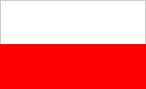
The Flag of Poland

The Flag of Poland

New page now online which looks at the wars of Poland from about 1600 to the Present.

At: http://www.historyguy.com/wars_of_poland.htm


Wars of 1939: Start of World War Two

16 Jul

Uploaded a new page called The Wars and Conflicts of1939: The Eve of World War Two.

at: http://www.historyguy.com/worldwartwo/wars_of_1939.htm


key words for this page include: war, wars, 1939, world war one, spanish civil war, spain, france, britain, germany, italy, albania, ethiopia, poland, sino-japanese war, arab revolt, palestine revolt, german occupation, occupation of czechoslovakia, occupation of memel, occupation of klaipeda, lithuania, slovak-hungarian war, little war, italian invasion of albania, chile coup 1939, ariostazo coup, soviet-japanese border war, battle of khalkhin gol, nomonhan, german invasion of poland, case white, fall weiss, soviet invasion of poland, world war two starts, poland invasion, winter war, finland, russia, soviet union, russian invasion.


Follow Historyguy.com on Twitter

22 Jun

A new page was added on 6/21/09 for those who want to follow Historyguy.com updates on Twitter.  Go to:

http://www.historyguy.com/twitter.htm or http://twitter.com/historyguycom

 
No Comments

Posted in History


Wars and Conflicts Between Tibet and China

17 Apr

With the recent publicity surrounding the ongoing repression in Tibet by the Chinese Communist Party, and the public protests around the world as the Olympic torch makes its way to Beijing, I have received several queries from readers about the history of conflicts between Tibet and China. 

There is a new web page on the historyguy.com site detailing some of these Sino-Tibetan Wars and Conflicts.  It is at: http://www.historyguy.com/tibet_china_wars_conflicts.html

While normally I take as neutral a position as possible while explaining world conflicts on the main historyguy.com website, and leaving my more opinionated commentary for this blog, I come down against the continued repression by the Chinese Communist Party in Tibet.  I see a distinction in identifying the brutality and evil of the occupation as sourced in the Communist ideology than in any innately Chinese cultural aspects.  When an authoritarian, dictatorial regime conquers a smaller, basically defenseless nation, it can never be justified.  I liken the Chinese occupation of Tibet with the other evil occupations of history, such as the Nazi occupation of Czechoslovakia, or the Soviet conquest of the Baltic States (Latvia, Lithuania, and Estonia).

Those once-captive nations eventually regained their freedom, and one day too, Tibet may once again see the back-end of the Communist occupying forces, just as, after the 1911 Revolution, Tibet saw the last of the Manchu Imperial occupation army.   


The Length of American Wars: Update for Iraq and Afghanistan

23 Mar

On March 19, 2008, the world noted the 5th anniversary of the invasion of Iraq.  The Iraq War is now the third longest war in American history, after the Vietnam War and the continuing war in Afghanistan.

Below is a look at America’s major wars and their length in months. Time periods are rounded up or down for ease of comparison. Current conflicts are italicized and are colored red. The longest wars are listed first in descending order by length. The start dates reflect when the United States entered the wars.

Vietnam War–August, 1964 to April, 1975= 129   months (American involvement began in the late    1950s, but major U.S. combat forces began taking part in large-unit combat in 1964.  August, 1964 is the month of the Gulf of Tonkin incident and the U.S. bombing of North Vietnamese targets.)       

American Revolution–April, 1775 to September, 1783= 100    months


Afghanistan–    October, 2001 to Present (as of March, 2008)= 78    months


Iraq War–March,    2003 to Present (as of March, 2008)= 60 months


U.S. Civil War–April, 1861 to April, 1865= 48    months


World War II–December, 1941 to September, 1945= 45    months


World War I–April, 1917 to November, 1918= 19    months


Korean War– June, 1950 to July, 1953= 37 months


War of 1812–June, 1812 to February, 1815= 32 months


U.S.-Mexican War– May, 1846 to February, 1848= 21    months


Spanish-American War–April, 1898 to August, 1898= 5    months


Gulf War–January, 1991 to March, 1991= 3 months


Source:  http://www.historyguy.com/american_wars_by_length_of_time.html


History of Wars between Serbia and Kosovo

17 Feb

For hundreds of years, the people of Serbia have considered the region of Kosovo to be the homeland of their history and culture. From the late 1300′s until 1912 however, this area was ruled by the Ottoman Turks, an Islamic people who once controlled a vast empire. Over the course of Ottoman Turkish rule, many Serbs either left Kosovo or converted from Christianity to Islam. Also, the Albanian Muslim (a Muslim is someone who believes in Islam) population of the area grew, until the majority of Kosovo inhabitants were no longer Serb Christians.

Albanians and Serbs are quite different in terms of language, religion and culture. Ever since Serbia acquired Kosovo in the First Balkan War (1912), conflict between these two groups has erupted periodically in this disputed region.

Below is a listing of these conflicts accompanied by a brief description.

NOTE: For the purposes of categorizing these conflicts, the term "Kosovo War" is used to name the wars between Serbs and Kosovar Albanians. Also, the use of the Serb term "Kosovo" rather than the Albanian version "Kosova" is not meant to imply favoritism or bias. "Kosovo" is the name that most Americans and Westerners know the region by and that is the name used here for clarity.

First Kosovo War (1912-1913)–In the brief First Balkan War (1912-1913), Serbia, along with other Balkan nations, succeeded in ending Ottoman Turkish rule in south-eastern Europe. As a consequence of this war, Albania became independent and the largely Albanian-inhabited region of Kosovo became a part of Serbia. Serbs had long claimed this area, citing its history as a part of the Serbian Kingdom which existed in the Middle Ages.

The Kosovars had already begun a rebellion against the Turks and wished to join with the new nation of Albania. Occupying Serb and Montenegrin troops and Kosovo guerrillas clashed. In the fighting and subsequent repression, approximately 20,000 Kosovars perished, while tens of thousands more fled to other countries. Many atrocities were carried out by the "kamitadjis," Serb paramilitary forces which officially operated independently of the Serb army but engaged in brutal repression of the civilian population. Note that in the Bosnian and Kosovo Wars of the 1990′s, Serb paramilitary forces in the same vein as the kamitadjis operated freely.

Second Kosovo War (1915-1918)–This conflict can be considered a part of World War One. Serbia was invaded by the armies of Austria-Hungary, Germany and Bulgaria (along with Turkey they were known as "The Central Powers"). The Serb army and government fled before the armies of the Central Powers in the winter of 1915. They marched through the mountains of Kosovo and Albania toward the sea where naval ships of the British and French (known as "The Allies") rescued them to continue the war from bases in Greece. During this retreat through Albanian-populated areas, the Kosovars exacted revenge on the Serbs for their conquest a few years earlier. Albanian guerrillas ambushed small units, killed and mutilated soldiers who became cut off from the main Serb forces and generally made the retreat as difficult as possible for the Serb army. Between the attacking Central Powers, the Albanians and the weather, roughly half of the 300,000 Serb soldiers who began the retreat never made it to the sea. The Albanian rebels, or "kaçaks" as they were called, also fought against the Austro-Hungarian and Bulgarian occupiers of Kosovo.

Third Kosovo War (1918-1924)–With the defeat of the Central Powers, Serbia joined with Montenegro and the formerly Austro-Hungarian areas of Slovenia, Bosnia and Croatia to form the new nation of Yugoslavia. The new kingdom’s government and army were dominated by Serbs. The king of Serbia became the first king of Yugoslavia, and the Yugoslav army was created with the old Serb army as its nucleus.

The Serb/Yugoslav army reoccupied Kosovo in 1918 but faced resistance from the Albanian Kosovar kaçaks, who did not want a return to Serb rule. As the army re-imposed government rule, many atrocities occurred, in part fueled by Serb desire for revenge over the harassment they suffered in the retreat of 1915. Massacres and the burning of villages were tactics employed to break the back of the rebel resistance. The Yugoslav government also banned the teaching of the Albanian language in the schools and encouraged immigration of Serbs and Montenegrins into Kosovo from other parts of Yugoslavia.

The rebels based in northern Albania formed the Committee for National Defense of Kosovo, also known as the Kosovo Committee or "KK" for short. The KK smuggled arms across the border and conducted raids against government forces. In May, 1919, the KK called for a mass uprising in Kosovo, and nearly 10,000 poorly armed rebels were driven into the mountains by a Yugoslav army equipped with modern machine guns and artillery. The KK continued the guerrilla struggle from bases in northern Albania until 1924. In that year, Yugoslavia’s military helped Ahmed Zogu, Albania’s former Prime Minister, regain power. In 1923, the KK had aided in Zogu’s overthrow from their bases in northern Albania. In return for Yugoslavia’s military aid, Zogu (who later became King Zog), closed down the KK’s guerrilla bases and effectively ejected them from Albania. This brought an end to the armed struggle in Kosovo.

Fourth Kosovo War (1941-1944)–This conflict can be considered a part of World War Two. In 1941, Germany, Italy and Bulgaria (the "Axis") invaded Yugoslavia and divided the country between them. Kosovo was occupied by the Italians, who attached it to Albania, which had been conquered by Italy in 1939. Most Kosovar Albanians welcomed the Italian occupiers, especially when Axis forces stood by and did not interfere as gangs of Kosovar Albanians attacked Serb and Montenegrin settlers. It is estimated that between 3,000 and 10,000 Serbs died and 30,000 and 100,000 fled Kosovo in this period. After Italy’s surrender to the Allies on September 8, 1943, German forces occupied Kosovo and Albania. The Germans encouraged attacks against the Serbs and used local Albanians to help them round up local Jews for their death camps.

While no extensive resistance to the Axis developed in Kosovo, most of the central portion (Bosnia-Hercegovina and Montenegro) of the old Yugoslavia was embroiled in bloody warfare against the Germans and Italians. The Communist Partisan army of Josip Broz Tito waged an effective guerrilla campaign which tied down hundreds of thousands of Axis soldiers. Most Kosovo Albanians distrusted the Partisans due to the perception that it was a largely Serbian organization and because most Muslim Albanians were anti-Communist. Some Kosovo Partisan units were formed and began striking at Axis forces in early 1943, but by and large, the Communist Partisan organization in Kosovo was quite weak.

In order to encourage more Kosovo Albanian participation in the war against the Axis, Tito announced in January, 1944, that after the war Kosovo would have the right to secede from Yugoslavia and join with Albania. Tito never intended to abide by this declaration and when Partisan units liberated Kosovo from the Germans in late 1944, a new conflict began in the Drenica valley of Kosovo.

Drenica Rebellion (or Polluzha’s Rebellion) (Late 1944-March 1945)–Shaban Polluzha was a Kosovar Albanian Partisan leader who believed Tito’s declaration that Kosovo could join with Albania. When he was ordered to take his 8,000 Kosovo Partisans north into Croatia to combat German troops, he refused, sparking an attack by the Titoist Partisan army. It is estimated that 20,000 Kosovar Albanians joined his rebellion. During the fighting and later Yugoslav Partisan reprisals, some 44 villages were reported destroyed. Tito’s forces put down the rebellion completely. After the war, Tito became the dictator of a Communist Yugoslavia. During his reign, Tito managed to suppress nationalist and ethnic tensions thoughout Yugoslavia.

Pristina Student Demonstrations (Spring, 1981)–After Tito’s death in 1980, Yugoslavia began to show signs of dissolution. On March 11, 1981, a small university student demonstration in Kosovo’s capital of Pristina turned into a general plea for democracy and Albanian nationalism. The students were somewhat influenced by the recent rise of the Solidarity movement in Communist Poland. On March 26, students and police clashed, leaving 37 injured. High school students and factory workers joined the protests demanding either Kosovo independence or union with Albania. At this point, Yugoslav special police with tanks entered Pristina. In the violence that followed, the government claims only eleven died and 57 were injured. Other reports put the death toll at hundreds. After the protests were broken up, thousands were arrested and put on trial.

It should be noted though, that administration of Kosovo was in the hands of local Albanian Communists, and this should not be interpreted as a strictly Serb-Albanian conflict. The protests were directed more at the Yugoslav government as a whole.

Sixth Kosovo War (1998-1999)–The Kosovo Liberation Army began a guerrilla war in February, 1998 against Serb Yugoslav authority. On March 24, 1999, in response to atrocities committed by the Serbs and their unwillingness to negotiate at the peace table (The Rambouillet Conference), the North Atlantic Treaty Organization (NATO) began a 78-day air campaign which succeeded in causing Serb leader Slobodan Milosovic to withdraw his army from Kosovo.

Kosovo Secession from Serbia (Feb. 17, 2008)–After existing as a UN-Administered part of Serbia since the 1998-1999 Kosovo War, the government of Kosovo declared its independence from Serbia. The Serbian government opposed this secession.

LINK: http://www.historyguy.com/kosovar_serb_warfare.html

SOURCES:

1. Judah, Tim. Kosovo: War and Revenge. New Haven: Yale University Press, 2000.

2. Ignatieff, Michael. Virtual War: Kosovo and Beyond. New York: Metropolitan Books, 2000.

3. Stavrianos, L.S. The Balkans Since 1453. New York,New York: Holt, Rinehart and Winston, 1966.

History: Independent Albania–http://www.albanian.com/main/history/independent.html

Please cite this source when appropriate:

Lee, Roger A. "The History Guy: Warfare and Conflict Between Kosovar Albanians and Serbs Since 1912"

http://www.historyguy.com/kosovar_serb_warfare.html 

Copyright © 1998-2008 Roger A. Lee and History Guy Media; Last Modified: 02.17.08


Anglo-Iraqi Wars

17 Nov

This page lists and explains the five wars fought between the United Kingdom and Iraq. The word "Anglo" refers to England, once known as "Angle Land," which is part of the island of Great Britain, which is the primary part of the United Kingdom.

1st Anglo-Iraq War: May 1920 to Feb. 1921

The Great Iraqi Revolution (known in Iraq as Ath Thawra al Iraqiyya al Kubra and by the British as the Arab Revolt of 1920-Rebellion by Iraqi Arabs against the rule of the British Mandate. The rebellion was suppressed by the British military. This can be considered the First Anglo-Iraqi War.

The immediate causes of this conflict arose out of the results of the British conquest of the Mesopotamian region from the Ottoman Turks during World War I. Following that war, the British established, with League of Nations approval, a colonial-style Mandate over the region now named “Iraq.” Many Iraqi nationalists, who believed independence would result from the ejection of the Turks, were severely disappointed with the establishment of the British Mandate. Other, related events and issues also inflamed Iraqi Arab opinion against the British. The Mandate government almost completely excluded Iraqis, as the British imported experienced civil servants from India (also ruled by Britain) to help administer the country. In northern Iraq, the British allowed thousands of Christian refugees escaping persecution in Turkey, to settle in mostly Muslim Iraq.

2nd Anglo-Iraq War: April 18, 1941 to May 30, 1941

The Anglo-Iraqi War of 1941, also known as the Rashid Ali Coup, was a relatively small, but very significant part of the Second World War. Since the ending of the British Mandate and the advent of full Iraqi independence in 1932, Britain retained a great deal of military influence in Iraq, despite lingering opposition from many Arab nationalists. One of these nationalists, Rashid Ali, seized power in Baghdad and refused British requests to allow British military forces to enter Iraq. Britain at this time was fighting German and Italian forces in North Africa and were preparing to invade Vichy French-held Syria. (The Vichy French were working with the Germans and British and Free French forces needed to secure the region). Believing promises of German support, Rashid Ali ordered his forces to attack British bases in western Iraq and to oppose the landing of British forces at the southern city of Basra. German support appeared in the form of a small number of Luftwaffe fighter planes, and the British forces quickly defeated the Iraqi military.

3rd Anglo-Iraq War: Aug. 2, 1990 to Feb. 1991

The Second Persian Gulf War (Also known as “Operation Desert Storm”)— On August 2, 1990, Iraqi forces invaded and quickly conquered the small, oil-rich emirate of Kuwait. Almost immediately, an international coalition of nations gathered a powerful military force under the authority of the United Nations and the leadership of the United States, first to defend the oil-rich kingdom of Saudi Arabia, and secondly, to force Iraq to withdraw from occupied Kuwait. From the beginning of the crisis, the United Kingdom, led by Prime Minister Margaret Thatcher, worked very closely with the U.S. in assuming a determined posture against Saddam Hussein’s territorial ambition. Click on the blue link above for more detail on the war.

4th Anglo-Iraq War: 1991 to March 19, 2003

The "No-Fly Zone War" pitted the air and naval forces of the United States and the United Kingdom against the air defenses of Iraq. This conflict was a direct result of the agreements which ended the fighting in the Second Persian Gulf War (Also known as “Operation Desert Storm”). Click on the blue "No-Fly Zone War" link above for more detail on the war.

5th Anglo-Iraq War: March 19, 2003 to Present

The Third Persian Gulf War , known as "Operation Telic" by the British, and "Operation Iraqi Freedom" by the U.S., ousted Iraqi dictator Saddam Hussein from power and led to the occupation of Iraq by British and American forces. Click on the blue link above for more detail on the war.

Please cite this source when appropriate:

Lee, R. "The History Guy: Anglo-Iraq Wars

http://www.historyguy.com/anglo-iraq_wars.html


Pages on Middle Eastern History


Iraq War

Gulf War

Arab-Israeli Conflict

Wars of Egypt

The Barbary Wars

Wars of Iraq

Anglo-Iraqi Wars

Anglo-Iraqi War of 1941

Saudi-Yemen Conflict

Iranian HostageCrisis 

"No-Fly Zone" War

Attack on the USS Cole

Yemeni Tribal Uprising (1998)